


































News


 电商部
电商部  2026-02-04 10:17:42
 Performance Testing Standards for Wide Temperature DDR5
The core value of Wide Temperature DDR5 lies in its stability and reliability in extreme environments, so performance testing must focus on three core dimensions: temperature adaptability, stability, and reliability. It should comply with industrial or automotive-grade testing standards, verifying product performance through multiple rounds of rigorous tests to avoid scenario adaptation failures due to incomplete testing.
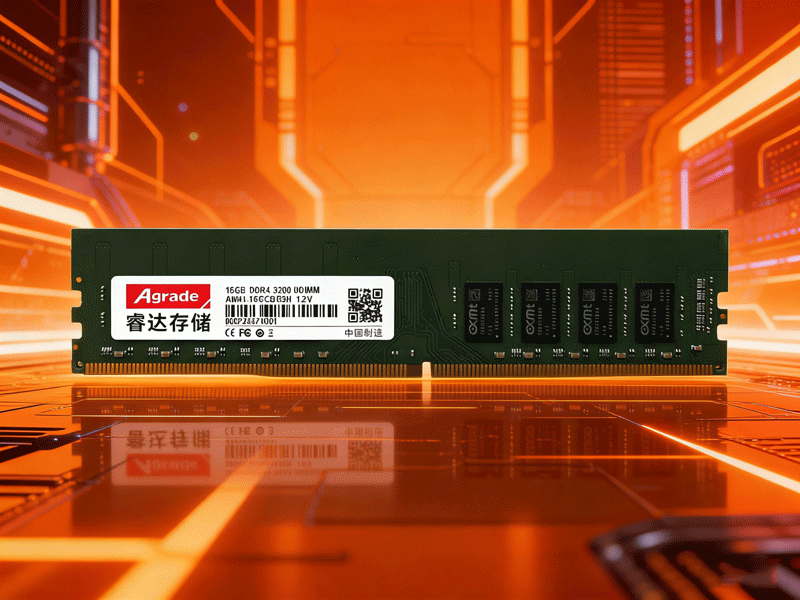
Temperature adaptability testing is the core project for Wide Temperature DDR5, covering the entire operating temperature range. Testing uses high and low-temperature chambers to simulate extreme environments, conducting 72-hour stability tests at key temperature points such as -40°C, 25°C, 85°C, and 125°C. The requirements are that bandwidth fluctuation does not exceed 3% and the data error rate is lower than 10⁻¹². Low-temperature startup testing is also required, with 100 power-on/off cycles at -40°C without startup failures. In high-temperature continuous operation tests, the module must operate at 100% load in a sealed 85°C environment for 48 hours without data loss or performance degradation.
Stability and reliability testing focus on long-term operation capabilities. This includes temperature cycling testing and vibration testing. Temperature cycling testing involves 1000 cycles between -40°C and 125°C at a rate of 10°C/min, requiring no deformation of heat dissipation structures and performance degradation of no more than 5%. Vibration testing simulates the vibration conditions of automotive and industrial equipment, ensuring no solder joint detachment or chip damage through tests at different frequencies. Additionally, ESD protection testing is conducted, with contact discharge of ±8kV and air discharge of ±15kV, requiring no functional abnormalities after testing.
Performance parameter testing is tailored to actual application needs, including transfer rate, latency, and power consumption testing. At different temperature points, the actual transfer rate is tested to ensure it meets the nominal value, and latency fluctuation is within a reasonable range. Power consumption testing verifies performance under the standard 1.1V voltage, ensuring low-power design is suitable for small industrial devices. Error correction capability testing validates the effectiveness of On-Die ECC, with 100% correction rate for artificially injected single-bit errors and no multi-bit error propagation.

-
Products
Advantages
-
Solutions
-
News
About us
-
Contact us
Tel:+86 19926658803
Whatsapp:+86 19926658803
lianle1210@163.com
Address: 30CF, Caihong Building, Caihong Road, Futian District, Shenzhen City, Guangdong Province, China



Friendly Links:
