





News


 电商部
电商部  2026-02-25 18:25:08
 Storage Principle of Wide Temperature TF Cards: Revealing Data Stable Storage Technology
At its core, the storage principle of a Wide Temperature TF Card is based on the electrical erasable and programmable characteristics of flash memory chips, similar to standard TF Cards. However, to ensure stable data storage in extreme environments, Wide Temperature TF Cards incorporate specialized optimizations in storage cell design, data read/write control, and environmental protection. These optimizations work together to prevent data loss or corruption caused by extreme temperatures, vibrations, or power fluctuations. Understanding this principle is key to understanding why Wide Temperature TF Cards are more reliable than standard TF Cards in harsh conditions.
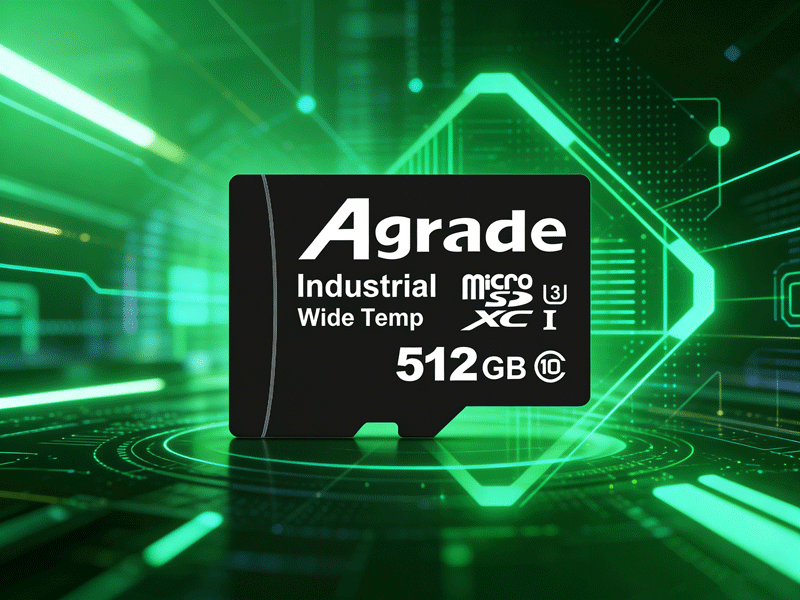
The core storage component of a Wide Temperature TF Card is the industrial-grade NAND flash memory chip, which is available in SLC (Single-Level Cell) or MLC (Multi-Level Cell) types. The basic storage unit of a flash chip is the floating-gate transistor, which stores data by trapping electrons in a floating gate. When electrons are injected into the floating gate, the transistor is in a "0" state; when electrons are released, it is in a "1" state. This electrical erasable and programmable process is the foundation of flash memory storage.
The key difference between Wide Temperature TF Cards and standard TF Cards lies in the type of flash chip used. Wide Temperature TF Cards use SLC or MLC chips, which are more stable in extreme temperatures than the TLC (Triple-Level Cell) chips used in standard TF Cards. SLC chips store only one bit of data per floating gate, which simplifies the structure and reduces electron leakage. This means that even in extreme temperatures (-40°C to 95°C), the electrons in the floating gate remain stable, preventing data corruption. MLC chips store two bits of data per floating gate, offering a balance between capacity and stability, and are also more temperature-resistant than TLC chips.
In addition to the flash chip, the industrial-grade controller chip is critical for data stability. The controller acts as the interface between the flash chip and the device, managing read/write operations, data encryption, error correction, and wear leveling. Wide Temperature TF Cards use controllers specifically designed to operate in extreme temperatures, with a wide operating temperature range that matches the flash chip. The controller’s most important function is error correction, which is achieved through ECC (Error-Correcting Code) algorithms.
When data is written to the Wide Temperature TF Card, the controller encodes the data and generates an ECC code, which is stored alongside the data. When the data is read back, the controller uses the ECC code to detect any errors that may have occurred during storage or transmission. If minor errors are detected (up to 512 bits per 512-byte sector), the controller automatically corrects them, ensuring data accuracy. This is particularly important in harsh environments, where temperature fluctuations and electromagnetic interference can increase the risk of data errors.
To prevent data loss due to sudden power loss, Wide Temperature TF Cards are equipped with power-off data protection technology. When the device’s power is suddenly cut off (e.g., due to a power outage or equipment failure), the controller quickly saves any pending data to a stable memory block in the flash chip. This prevents the data from being lost or corrupted, which is critical in industrial applications where data integrity is essential.
Another important optimization is wear leveling technology. Flash memory chips have a limited number of program/erase cycles (e.g., 100,000 cycles for SLC chips, 10,000 cycles for MLC chips). If the same memory cells are used repeatedly, they will wear out faster, leading to data loss. Wear leveling algorithms distribute read/write operations evenly across all memory cells, ensuring that each cell is used equally. This extends the overall lifespan of the Wide Temperature TF Card and ensures long-term reliability.
Finally, the physical protection design of Wide Temperature TF Cards also contributes to data stability. Epoxy resin vacuum packaging isolates the flash chip and controller from moisture, dust, and temperature changes, while the reinforced circuit board protects against vibrations and physical damage. Together, these hardware and software optimizations ensure that Wide Temperature TF Cards can store data reliably in even the harshest environments.

-
Products
Advantages
-
Solutions
-
News
About us
-
Contact us
Tel:+86 19926658803
Whatsapp:+86 19926658803
lianle1210@163.com
Address: 30CF, Caihong Building, Caihong Road, Futian District, Shenzhen City, Guangdong Province, China



Friendly Links:
