




News


 电商部
电商部  2026-01-26 10:32:20
 The core difference between wide-temperature solid-state drives and ordinary SSDs, choose after read
Although wide temperature solid-state drives and ordinary consumer SSDs have similar appearance and use universal interfaces such as SATA and M.2, their design goals, core performance, reliability standards, and application scenarios have essential differences. The former focuses on long-term stable operation in extreme environments, while the latter emphasizes cost-effectiveness and peak performance in daily office and home scenarios. The technical routes and product positioning of the two are completely different. When selecting, it is necessary to clarify the usage scenario requirements to avoid equipment failure, data loss, or cost waste caused by mismatches.
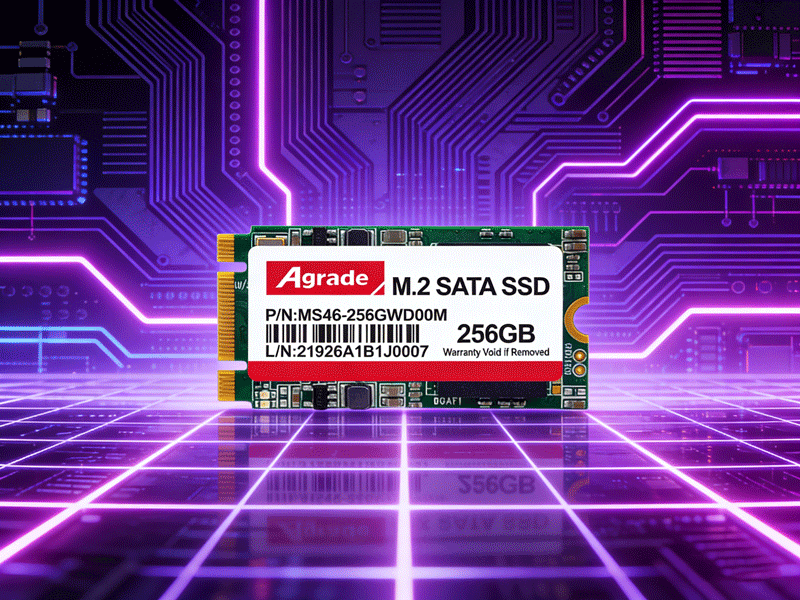
The core difference lies in temperature adaptability and long-term reliability. The standard operating temperature range for ordinary consumer grade SSDs is only 0 ℃~70 ℃. Beyond this range, startup failures and sudden drops in write speed are prone to occur in low-temperature environments. Automatic speed reduction protection will be triggered in high-temperature environments, and long-term operation at extreme temperatures will accelerate flash aging, shorten the service life, and even cause chip burnout; Through industrial grade device selection and firmware temperature adaptation algorithm optimization, wide temperature SSDs can stably cover a temperature range of -40 ℃~85 ℃ or even wider. Some military grade products can withstand extreme temperature differences of -55 ℃~125 ℃. In terms of reliability, the error rate control of wide temperature products is more stringent, with UBER reduced to below 10 ^ -17. At the same time, TBW (total write capacity) is usually 3-5 times that of consumer grade SSDs, supporting 7 × 24-hour uninterrupted operation, and MTBF (mean time between failures) can reach more than 1 million hours, which can meet the long-term operational needs of core scenarios such as industrial control and rail transit.
In addition, wide temperature SSDs have strengthened industrial grade protection in terms of data security and environmental adaptability, which are advantages that ordinary consumer grade SSDs do not possess. Most industrial grade wide temperature SSDs have built-in tantalum capacitor power-off protection modules, which can provide sufficient power for caching data to be downloaded within 5ms after power-off, avoiding data loss caused by unexpected power outages in extreme environments; The hardware design adopts anti vibration, anti electromagnetic interference, and impact resistant structures, which can adapt to complex working conditions in industrial sites, bumpy vibrations in rail transit, electromagnetic interference in on-board equipment, and other scenarios. Ordinary consumer grade SSDs lack these industrial grade protective designs and can only meet the needs of regular environments such as office and home use, unable to cope with complex working conditions such as extreme temperature, vibration, and electromagnetic interference. At the same time, wide temperature SSDs support real-time status monitoring and firmware upgrade functions for S.M.A.R.T, which facilitates equipment operation and maintenance in industrial scenarios and further ensures system continuity.
The core difference lies in temperature adaptation and reliability. Ordinary SSDs that exceed the temperature range of 0 ℃~70 ℃ are prone to startup failures and a cliff like decline in performance, and long-term operation can accelerate component aging; Wide temperature SSDs can operate stably within a range of -40 ℃~85 ℃ or even wider through industrial grade device selection and firmware temperature adaptation, with error rate controlled at an extremely low level. In terms of lifespan, the TBW (total write capacity) of wide temperature products is usually several times that of consumer grade, supporting 7 × 24 hours of uninterrupted operation.
In addition, wide temperature SSDs also enhance data security and environmental adaptability. Most products have built-in tantalum capacitor power-off protection modules to prevent data loss caused by unexpected power outages in extreme environments; The hardware design has anti vibration and anti electromagnetic interference characteristics, suitable for complex working conditions in industrial sites. Ordinary SSDs lack these industrial grade guarantees and are only suitable for regular scenarios such as office and home use.

-
Products
Advantages
-
Solutions
-
News
About us
-
Contact us
Tel:+86 19926658803
Whatsapp:+86 19926658803
lianle1210@163.com
Address: 30CF, Caihong Building, Caihong Road, Futian District, Shenzhen City, Guangdong Province, China



Friendly Links:
