










News


 电商部
电商部  2026-02-25 18:23:49
 Wide Temperature TF Card Buying Guide: How to Choose Capacity and Speed
Choosing the right Wide Temperature TF Card requires careful consideration of two core parameters: capacity and speed. Selecting the wrong capacity or speed can lead to wasted resources, poor performance, or even equipment failure. Unlike consumer TF Cards, where larger capacity and higher speed are often preferred, Wide Temperature TF Cards are designed for specific industrial and outdoor applications, so the key is to match the card’s specifications to the device’s requirements. This guide will help you navigate the selection process and make an informed decision.
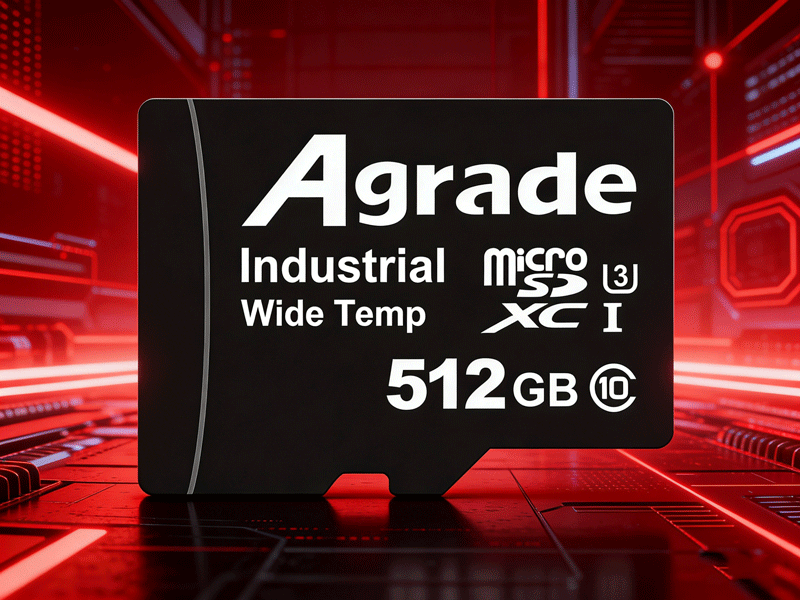
First, let’s focus on capacity selection. Wide Temperature TF Cards are available in a range of capacities, including 8GB, 16GB, 32GB, 64GB, 128GB, and occasionally 256GB for high-capacity needs. The right capacity depends primarily on the device’s data storage requirements and read/write frequency. For example, outdoor surveillance cameras typically generate 10GB to 20GB of video data per day (depending on resolution and frame rate). If you need to store 7 days of footage, a 64GB or 128GB card would be appropriate. Industrial control devices, on the other hand, often generate small amounts of data (e.g., sensor readings) in real time, so an 8GB or 16GB card may be sufficient.
It is important to note that the actual usable capacity of a Wide Temperature TF Card is slightly less than the labeled capacity (typically 10% less) due to differences in binary and decimal number systems. For example, a 64GB card will have approximately 58GB of usable space. Additionally, most devices reserve a small portion of the card’s capacity for system operations, so it is recommended to预留 at least 20% of free space to avoid capacity overflow. Capacity overflow can lead to data corruption, slow read/write speeds, or inability to write new data, which is critical in industrial applications where data loss is unacceptable.
Next, let’s consider speed selection. The speed of a Wide Temperature TF Card is measured by two main standards: UHS (Ultra High Speed) speed class and Video Speed Class (VSC). The UHS speed class is primarily used for industrial applications and is divided into U1 (minimum sequential write speed of 10MB/s) and U3 (minimum sequential write speed of 30MB/s). The Video Speed Class is designed for video recording and is divided into V30 (30MB/s), V60 (60MB/s), and V90 (90MB/s), indicating the minimum sequential write speed required for smooth video recording.
For most industrial control devices, automotive navigation systems, and low-resolution outdoor cameras, a U1-class Wide Temperature TF Card is sufficient. These devices generate small amounts of data at a moderate rate, so the 10MB/s write speed is more than enough. For high-resolution outdoor surveillance cameras (e.g., 4K or 8K), automotive dashcams, and devices that require continuous high-speed data writing, a U3/V30 or higher class card is recommended. This ensures that video footage is recorded without lag, stuttering, or frame loss, which is critical for security and monitoring applications.
Another important factor to consider is the card’s speed stability across the entire temperature range. Unlike standard TF Cards, which may experience significant speed drops in extreme temperatures, high-quality Wide Temperature TF Cards maintain a constant speed across their operating temperature range. When purchasing, look for products that specify "full-temperature constant speed" to ensure reliable performance in all conditions. Avoid杂牌 cards that do not provide speed specifications, as they may experience severe speed degradation in extreme temperatures.
Finally, it is important to balance capacity and speed with cost. Higher capacity and speed cards are more expensive, so there is no need to overspend on a card with specifications that exceed your device’s needs. For example, if your industrial control device only requires 16GB of capacity and U1 speed, a 128GB U3 card would be a waste of money. By carefully assessing your device’s data storage and speed requirements, you can select a Wide Temperature TF Card that offers the best performance and value for your application.

-
Products
Advantages
-
Solutions
-
News
About us
-
Contact us
Tel:+86 19926658803
Whatsapp:+86 19926658803
lianle1210@163.com
Address: 30CF, Caihong Building, Caihong Road, Futian District, Shenzhen City, Guangdong Province, China



Friendly Links:
