




News


 电商部
电商部  2025-12-16 16:19:45
 eMMC vs UFS: Key Differences, Use Cases & Which to Choose in 2025
In the embedded storage landscape, eMMC (embedded MultiMediaCard) and UFS (Universal Flash Storage) dominate different market segments, with distinct technical advantages and application scenarios. Understanding their core differences is critical for engineers, product designers, and procurement teams to make informed decisions.
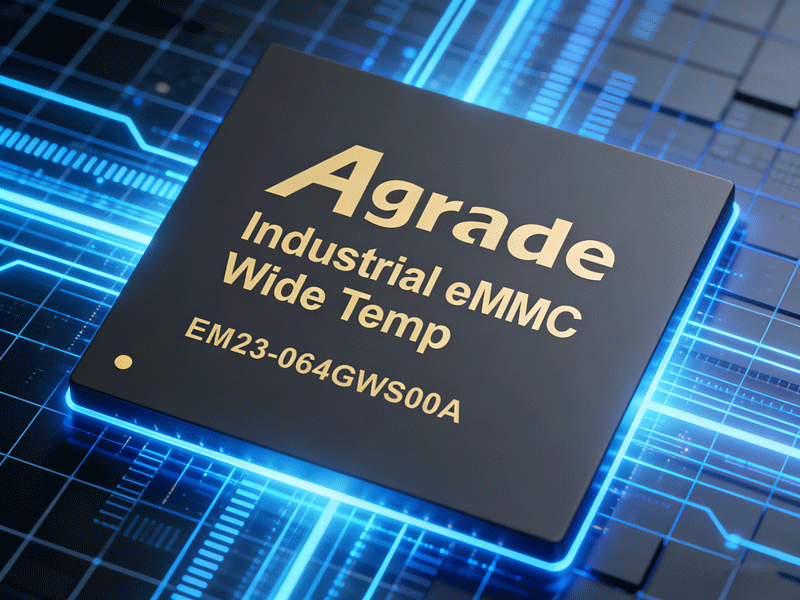
eMMC, introduced in 2006, integrates NAND flash, a controller, and a standard interface into a single package, featuring a parallel 8-bit data bus and half-duplex transmission (alternating read/write). The latest eMMC 5.1 supports HS400 mode, delivering theoretical read speeds up to 400MB/s and write speeds around 150MB/s, with random read performance of approximately 11K IOPS . Its greatest strengths lie in mature ecosystems, low complexity, and cost-effectiveness, making it ideal for budget-conscious devices. In contrast, UFS uses a serial differential interface with full-duplex transmission (simultaneous read/write), offering significantly higher performance—UFS 4.1 achieves sequential read/write speeds of 4350MB/s and 4200MB/s, with random read IOPS reaching 750K . However, UFS comes with higher costs and stricter design requirements.
Application-wise, eMMC holds 64.66% of global embedded storage sales as of 2025, primarily powering mid-to-low-end smartphones, smart TVs, wearables, and industrial controllers . Its wide temperature range (-40°C to 105°C for industrial grades) and simple integration suit cost-sensitive, low-to-medium performance needs. UFS targets high-end flagships, ADAS systems, and edge computing, where speed and low latency are paramount. For example, automotive UFS certified to AEC-Q100 outperforms eMMC by 2.5-6x in read/write, critical for autonomous driving data processing .
When choosing between them, cost-sensitive projects with moderate performance demands should opt for eMMC 5.1, while high-end devices requiring real-time data handling need UFS. By 2030, UFS is projected to capture 35% of the market, but eMMC will remain dominant in entry-level and industrial sectors .

-
Products
Advantages
-
Solutions
-
News
About us
-
Contact us
Tel:+86 19926658803
Whatsapp:+86 19926658803
lianle1210@163.com
Address: 30CF, Caihong Building, Caihong Road, Futian District, Shenzhen City, Guangdong Province, China



Friendly Links:
