




News


 电商部
电商部  2025-12-16 16:19:45
 Industrial eMMC: Key Specifications, Durability & Application in IoT/Automotive
Industrial-grade eMMC has become the backbone of IoT, automotive, and industrial automation systems, offering rugged performance and reliability tailored to harsh operating environments. Unlike consumer-grade counterparts, it undergoes rigorous testing to meet the stringent requirements of mission-critical applications.
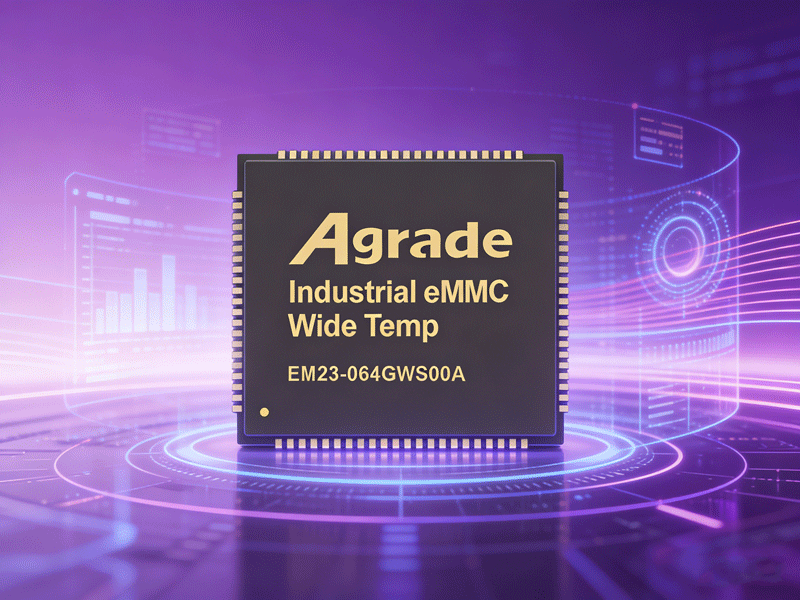
Core specifications distinguish industrial eMMC: operating temperature ranges from -40°C to 105°C (extending to -55°C to 125°C for military-grade variants), withstanding extreme heat in engine bays and cold in outdoor monitoring devices . Durability is a standout feature—industrial eMMC uses SLC or industrial-grade MLC NAND, supporting over 100,000 erase cycles and a data retention period of 10+ years, compared to 3,000-10,000 cycles for consumer TLC-based eMMC . Total Bytes Written (TBW) typically exceeds 50TB, enabling 24/7 continuous operation in industrial controllers and data loggers.
In automotive applications, eMMC powers infotainment systems, instrument clusters, and telematics, with 2025 market size expected to reach $12 billion and double by 2030 . These automotive-grade modules comply with AEC-Q100 standards, resisting vibration (up to 50G acceleration) and electromagnetic interference. Industrial IoT devices, such as smart sensors and PLCs, rely on eMMC’s low power consumption (sleep current μA) and stable data storage, even in dusty or humid conditions .
Key selection criteria include wide temperature support, erase cycle count, ECC error correction, and 掉电 protection. Leading manufacturers like Samsung, Kioxia, and Yangtze Memory offer industrial eMMC with MTBF (Mean Time Between Failures) exceeding 1 million hours, ensuring uninterrupted operation in critical infrastructure . As industrial digitization accelerates, the demand for high-reliability eMMC will grow, with the industrial eMMC market projected to surpass $8 billion in 2025 .

-
Products
Advantages
-
Solutions
-
News
About us
-
Contact us
Tel:+86 19926658803
Whatsapp:+86 19926658803
lianle1210@163.com
Address: 30CF, Caihong Building, Caihong Road, Futian District, Shenzhen City, Guangdong Province, China



Friendly Links:
